Three Rivers State Hospital
I Know This Much Is TrueThree Rivers State Hospital is a psychiatric institution whose changing grounds and routines shape Thomas Birdsey’s life and expose the tensions between treatment, confinement, and public safety. Set on land once belonging to the Wequonnoc Nation, it is at once a landscape of family visits and river walks, a system of locked doors and reviews, and a declining institution whose buildings eventually empty and close.
Site and historical landscape
The hospital stands on the southern border of Three Rivers, off the John Mason Parkway, a state highway leading toward the Connecticut shoreline. The sprawling grounds are bordered by the Sachem River to the rear and by the town fairgrounds to the north; the sacred burial grounds of the Wequonnoc Nation lie to the south. The setting therefore places the hospital beside both ordinary civic spaces and a landscape marked by a history that predates the town’s institutions.
The Indian cemetery on the hospital’s grounds is modest in scale, with a few rolling acres, roughly a hundred gravestones, and many nameless foot markers. At its center stands a ten-foot pyramid of fist-sized stones commemorating Samuel, the Great Sachem of the Wequonnoc Nation. The account connects his alliance with white settlers and conflict with neighboring peoples to the later contraction of the reservation: Three Rivers was incorporated in 1653 and expanded under a legal order controlled by white settlers, while the tribe’s land and population dwindled. The hospital consequently occupies more than a clinical site; its location carries the history of Indigenous land loss.
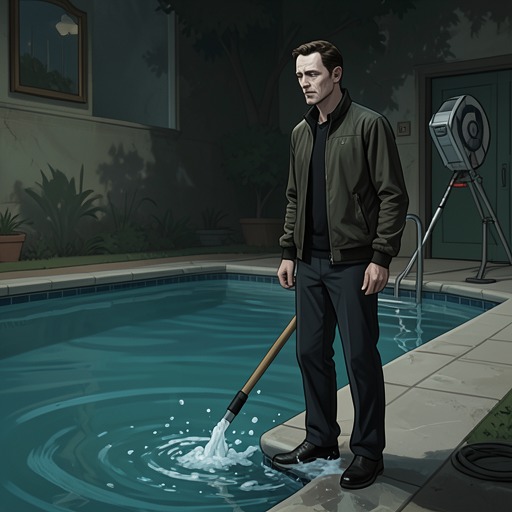
The hospital grounds also enter the brothers’ lives before they become an institutional setting. In the summer of 1969, Dominick Birdsey and Thomas, home from their first year of college and aged nineteen, worked seasonal jobs that included mowing the cemetery, clearing brush at the reservoir, and pumping out the town fairgrounds. Thomas’s voices had begun, Dominick later recalls, though their significance was not yet understood. The brothers’ early contact with the property thus predates Thomas’s long residence there and binds the hospital landscape to their shared youth.
Settle and the rhythms of residence
Thomas’s on-and-off home at the hospital was the Settle Building. Dominick’s Sunday routine made the institution part of family life: he signed Thomas out, took him to lunch, visited their stepfather or drove with him, and returned him before supper. This arrangement gave Thomas regular time beyond the ward while making clear that each outing ended with his return to the hospital. During their mother’s final illness, Dominick tried to visit her in New Haven two or three times a week and brought Thomas when he could, usually on Sundays. Thomas’s reactions shifted between resignation, grief, and hope, so that a visit or drive did not provide a stable measure of how he was coping.
At one stage, medication appeared to stabilize Thomas. After doctors changed his diagnosis from manic-depressive illness to paranoid schizophrenia, he received 200 milligrams of Thorazine daily and was granted a state-hospital grounds card. The card permitted him to walk with staff or family, a privilege he took pride in. Dominick and Dessa Constantine collected him outside Settle on Sunday afternoons and walked past the older brick buildings and the Ribicoff Research Center, across the rear boundary, and down to the Sachem River. Thomas liked to watch and listen to the moving water and sometimes waded in it. Their walks often ended at the Indian cemetery, where Dominick and Dessa studied the stones. The grounds offered Thomas a measure of movement and companionship, though that freedom remained conditional on staff or family supervision.
The contrast between this comparatively open routine and the hospital’s later decline is pronounced. Thomas had been a patient since 1970, while the institution itself contracted dramatically. Buildings that had once housed more than four thousand patients held only about two hundred inpatients by the time of Dominick’s later account. The Dix Building was boarded up, as were other older structures, and decay and downsizing had left only Settle and Hatch operating. The shrinking complex narrowed the available settings for care even as Thomas’s needs continued.
Hatch, security, and legal confinement
Hatch Forensic Institute occupied the rear of the hospital grounds as a maximum-security facility, surrounded by chain-link fencing and razor wire. It housed people whose cases had attracted public attention as well as patients with less sensational histories, including people with substance-related problems, mood disorders, and disruptive behavior. The narrative describes it as a place from which some people were released, but where for many patients the door seemed to swing only one way. That image reflects both the institution’s restrictive character and the town’s greater interest in containing perceived risk than in rehabilitation.
Thomas’s transfer into the forensic system followed his self-amputation in a public library. Five days after surgery, once his condition was stable enough for release from the surgical service, Dr. Ellis Moore filed a Physician’s Emergency Certificate with the judge of probate, identifying Thomas as dangerous to himself or others. His admission to Hatch under that certificate initiated a fifteen-day period of observation. A hospital representative told Dominick that the certificate required Thomas to remain for at least those fifteen court-ordered days while his risk was assessed. The procedure made his immediate release unavailable to his brother, regardless of Dominick’s wish to intervene.
The hospital’s legal climate was also shaped by fear of violence and political reaction. A separate case involving Jimmy Lane, a patient on a supervised day pass who wandered away and killed a child, reinforced public stereotypes of mentally ill people as unpredictable killers. The case became a political liability for the insanity defense and made not-guilty-by-reason-of-insanity decisions contentious. The novel places Thomas’s confinement within this broader pressure: clinical judgments and legal safeguards operate alongside public anger, institutional caution, and demands for security.
Hatch’s precautions could themselves intensify the difficulty of treating Thomas. A clinician explained that surveillance cameras, inspections, room checks, and security routines made the environment especially threatening for someone with paranoia, because they could be experienced as evidence of being watched. Thomas also interpreted ordinary teasing at meals or recreation as part of a conspiracy; his reactions could invite further teasing, prompting staff to work with him on strategies for those encounters. The account thus presents both the practical need to manage a secure ward and the way its procedures could aggravate the very fears they were meant to contain.
Institutional access shaped Dominick’s role as well. After Thomas’s admission, Dominick was barred from visiting until he obtained security clearance. He relied on telephone updates from Lisa Sheffer and conversations with Dr. Patel, who reported that Thomas was holding his own and that an infection at the skin graft had responded to stronger antibiotics. On a later visit, security staff authorized the meeting, and Thomas appeared hesitant, with dark circles under his eyes and pronounced jerky head movements. At another point, guards searched Thomas’s bag and Bible, emptied his belongings onto a conveyor belt, and passed them through an X-ray machine; afterward, an officer ordered the escorts to cuff him again. Such details make security a routine administered to bodies and possessions, not merely an abstract institutional policy.
Care, review, and the problem of placement
The hospital is not represented as uniformly cruel. In a discussion with Dominick, a staff member acknowledged that Thomas might fare better at Settle, where the security burden was lower, but rejected the idea that Hatch was simply a torture chamber. She described daily ward problems and the hardships of life there while also judging the care generally humane. Her assessment complicates the institution’s reputation: Hatch could provide care, yet it was not a place people wanted to remain, and its security measures could work against the needs of a paranoid patient.
Moving Thomas out of Hatch was not simply a matter of winning a decision. A clinician emphasized the difficulty of finding a placement because mental-health services were being downsized and there were fewer options than before. Dominick was also told of a rumor that Settle might close as early as March. The possible loss of the less restrictive setting made the question of release inseparable from the question of where Thomas could go. A change in legal status could not by itself supply a suitable place to live or receive care.
The Psychiatric Security Review Board ultimately voted unanimously to retain Thomas for one year, finding that he remained potentially dangerous to himself and others. His case was to be reviewed again in October 1991, with release or a second twelve-month period among the possible outcomes. Sheffer had requested a follow-up review after six months rather than twelve, but the longer retention period prevailed. The review process provided a formal timetable for reconsideration while leaving Thomas’s liberty dependent on a board’s assessment of risk and on the availability of a viable placement.
Closure and afterlife of the grounds
Settle closed in March 1992. Prosperine Albrizio was among the last groups of psychiatric patients discharged from the building before its doors shut. The later account finds no surviving records, or evidence that records ever existed, under Prosperine Tucci’s name; it also finds no evidence that she and Thomas knew each other during their long stays at Settle. Their possible proximity remains an archival gap rather than a confirmed relationship. The hospital’s records and institutional memory prove incomplete precisely where a reader might expect them to settle a connection.
Hatch, the last operating facility of Three Rivers State Hospital, closed in 1994. After a three-month trial, Dr. Richard Hume and four other physician-administrators were cleared of negligence charges related to the spread of AIDS and HIV at the institute. The remaining 127 inmates were transferred to Middletown, and the forensic hospital ceased to exist. The sequence joins a legal outcome to a material one: administrators were cleared, patients were moved, and the institution that had held them disappeared.
The abandoned grounds remain marked by the contrast between institutional possession and earlier Indigenous use. Once part of the sacred hunting and fishing lands of the Wequonnoc Nation, the property may again revert to the tribe through annexation for expansion. That possibility gives the hospital’s decline a significance beyond the end of its medical operations. Its buildings decay, but the land’s older history persists, linking Thomas’s confinement and the institution’s final closure to a wider story of who controls the place and whose histories its records preserve.